1310 PENDLETON STREET CINCINNATI, OH
| (513) 407-7077 | WED - SAT 11:30 AM - 4:00 PM

THE
ANNEX
NEWS


A knot of neon by Tong Zhang
University of Toronto, Canada
Science magazines — the serious ones, and even the popular-science ones — very often bring us stunningly beautiful photographs of what actually is. Natural splendor, the marvels of the world. They aren't art photographs; they don't denounce problems, or systems, or the routine aberrations of the human world. They are for the curious, for those with a child's soul. And yet the photographers who take them can be considered full-fledged artists. All the more so in these days of ours, when anything at all lays claim to artistic status.
The first of these three photographs shows a labyrinthine luminescent creature, a tangled knot of neon filaments. It is, in fact, a crab freshly hatched from its egg, at the earliest phase of its life — the larval stage known as zoea.
The image is by Tong Zhang, optical microscopy coordinator at the University of Toronto. Zoeas are normally microscopic, measuring between 0.25 and 1 mm (0.009–0.03 inches) in length.
Nature does not, as a rule, stage such chromatic carnivals. To the naked eye the larva appears far less saturated, almost dull. Its colors come from natural fluorescences present in its tissues and cells; Zhang used infrared and ultraviolet lasers to intensify that fluorescence. The technique dispenses with the dyes typically required when working with microscopic organisms, and makes them more vivid, easier to identify.
Pinning down the precise age of this zoea is no simple matter either. Its morphology suggests it hatched from its egg only recently. If it survives, it will pass into the stage known as megalopa. It will develop tiny pincers and begin to look like what it really is. A crab.

Light show by Josh Dury
Fairy Pool Waterfalls, Isle of Skye, Scotland
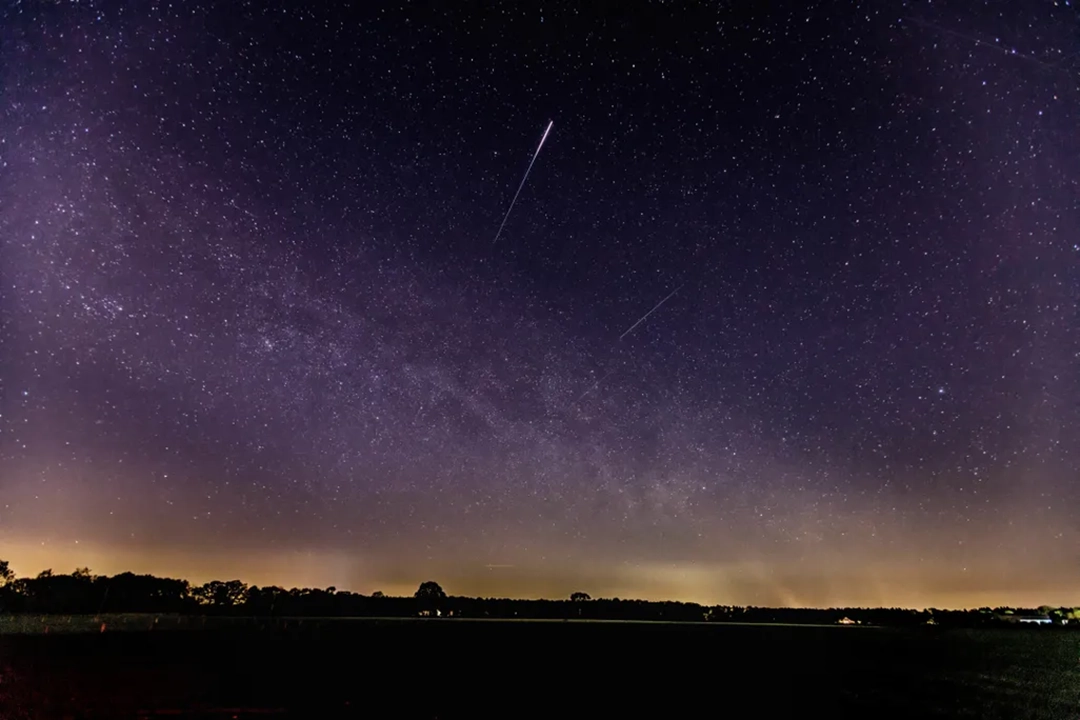
To the oldest meteor shower on record we owe the streaks cutting across this Scottish landscape. The Lyrids peaked on April 22, when photographer Josh Dury captured this spectacular image. In addition to the waterfalls, the mountains, the stars, and the silhouetted band of the Milky Way, the photograph shows meteors — tiny fragments of Comet Thatcher — burning up as they pass through Earth's atmosphere.
Comet Thatcher was officially discovered in 1861, though there are records of observations by Chinese astronomers going back to 687 BC. And throughout all the time this "dirty snowball" has been orbiting the Sun, it has been shedding fragments of itself. When Earth's orbit crosses those remnants, they enter our atmosphere at extremely high speeds, up to 50 km/s (111,847 mph).
They move so fast that the air ahead of them cannot get out of the way. Instead, it compresses violently, releasing intense heat. That superheated air is what makes the meteoroids glow and leave the trails we see in the image.
We can watch the Lyrids every spring, when Earth passes through the trail left by Comet Thatcher. The comet itself, however, won't be back until 2283 — a single orbit around the Sun takes it 415 years.
Fortunately, some people are out hunting shooting stars while nearly all of us are asleep.

Gummy hairs by Timothy Boomer
Eldorado National Forest, California, US
Cherry gummies are my favorite. Gummy candies are made with gelling agents, and that elastic texture of theirs is maddening. I ate plenty of them when I first arrived in the United States. When we begin adapting to a new life — one far less miserable — we mentally return to childhood, and within two or three months we consume everything we couldn't have in Cuba: compotes, sweets, gummies, of course. The phase doesn't last long, because in these lands sugar has evolved into a real killer.
Anyone with a similar weakness might be tempted to pop one of these little red gummies into their mouth. I wouldn't recommend it. Although they look like candy, they are in fact tiny glandular hairs from a snow plant (Sarcodes sanguinea). They are toxic. At least to the insects that try to feed on it. Known as trichomes, these hairs secrete toxic substances to protect the plant. From pests, from herbivores. Even from fools who might mistake it for candy.
The hairs are minuscule, typically only a few thousandths of a millimeter long. Photographer Timothy Boomer used a 7.5x microscopic objective to make them look large and fleshy — repellent or appetizing, depending on the viewer's taste. Snow plants are entirely red. They lack chlorophyll, so no greenish tones come through. They cannot photosynthesize the way ordinary plants do. They obtain their nutrients through a symbiotic — and promiscuous — relationship with the fungus Rhizopogon ellenae.
The fungus, in turn, maintains this same relationship with trees. Through its vast underground mycelial network, it carries water and minerals from the soil up to the roots of the trees. From those trees, it takes the sugars produced by photosynthesis. The snow plant exploits the alliance. It hooks its roots into the fungus and draws from it the nutrients that originally came from the trees. It uses the fungus as a bridge to reach the energy of photosynthesis without ever performing photosynthesis itself. This kind of arrangement is common in politics — and rampant on islands where cherry gummies are nowhere to be found.






In encounters with certain works of contemporary visual art, perception activates modes of association that situate aesthetic experience in territories where matter, gesture, and time intertwine. Elizabet Cerviño’s (Manzanillo, Cuba, 1986) exhibition The Rhythm of Resilience, recently presented at Gallery 114 in Ybor City, Florida, unfolds within this horizon.

Evelyn Sosa and Leticia Sánchez Honored for Their Artistic Contributions

.svg)