1310 PENDLETON STREET CINCINNATI, OH
| (513) 407-7077 | WED - SAT 11:30 AM - 4:00 PM

THE
ANNEX
NEWS

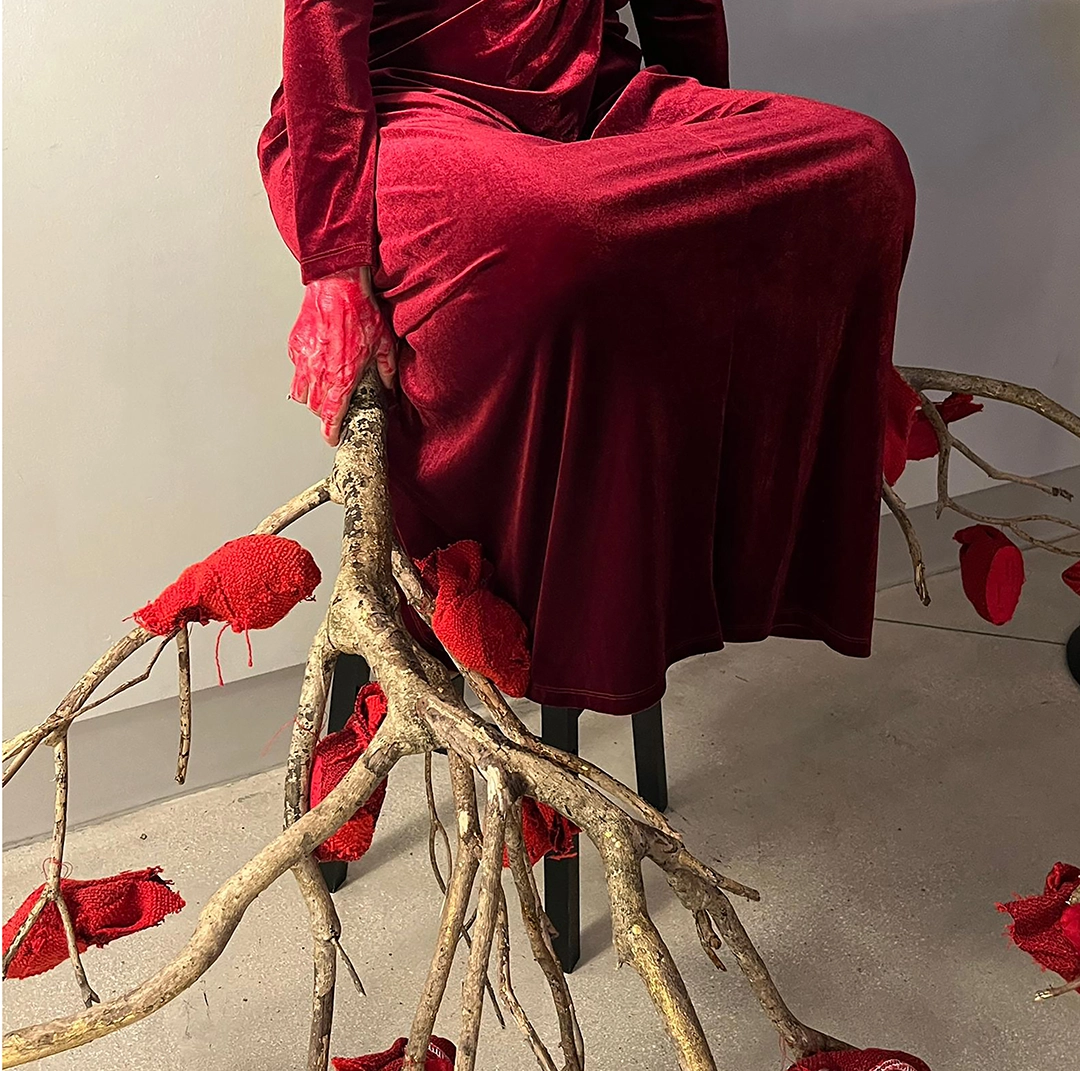
What Price Would You Put on My Heart (Performance)
Documentary Photograph
Dressed in red, barricaded behind a mask crowned with feathers as red as the dress itself, the visual artist Cirenaica Moreira (Havana, 1969) waited, seated on a stool, for the attendees of the performance—scissors in hand—to cut the hearts fastened to the dry, gilded branches she held.
There were thirty hearts. Signed. Numbered. To take one away, the interested party had to leave in a glass container whatever amount of money they considered appropriate.
In the room one could hear a musical selection playing on loop: Lascia ch’io pianga (Let Me Weep) by George Frideric Händel; Polifemo – Alto Giove by Nicola Porpora; Rêverie by Claude Debussy; the adagio from Toccata, Adagio and Fugue in C major, BWV 564 by Johann Sebastian Bach; Nocturne in E minor, Op. posth. 72, No. 1 by Frédéric Chopin; St. Matthew Passion, BWV 244 (Passio Domini Nostri J. C. Secundum Evangelistam Matthaeum / Matthäus-Passion) by Bach, among others.
It was the Sandrell Rivers Theater. It was January 24, 2025, the first edition of the Independent Theater Festival, where the performance What Price Would You Put on My Heart (2024) would be presented.
It was, of course, Miami.
Since December 2024 and up to the present month, Moreira—wearing that dress—has appeared / been read in various digital magazines: Rialta Magazine (So Far Away and So Dramatic. The Unrepresentable Theater of Nara Mansur; The Uncomfortable Diary of Anaïs Nin) and Hypermedia Magazine (4:48 Times New Roman 12). These are texts authored by her. She calls them “autofiction essays,” accompanied by works she conceived throughout 2024 and 2025.
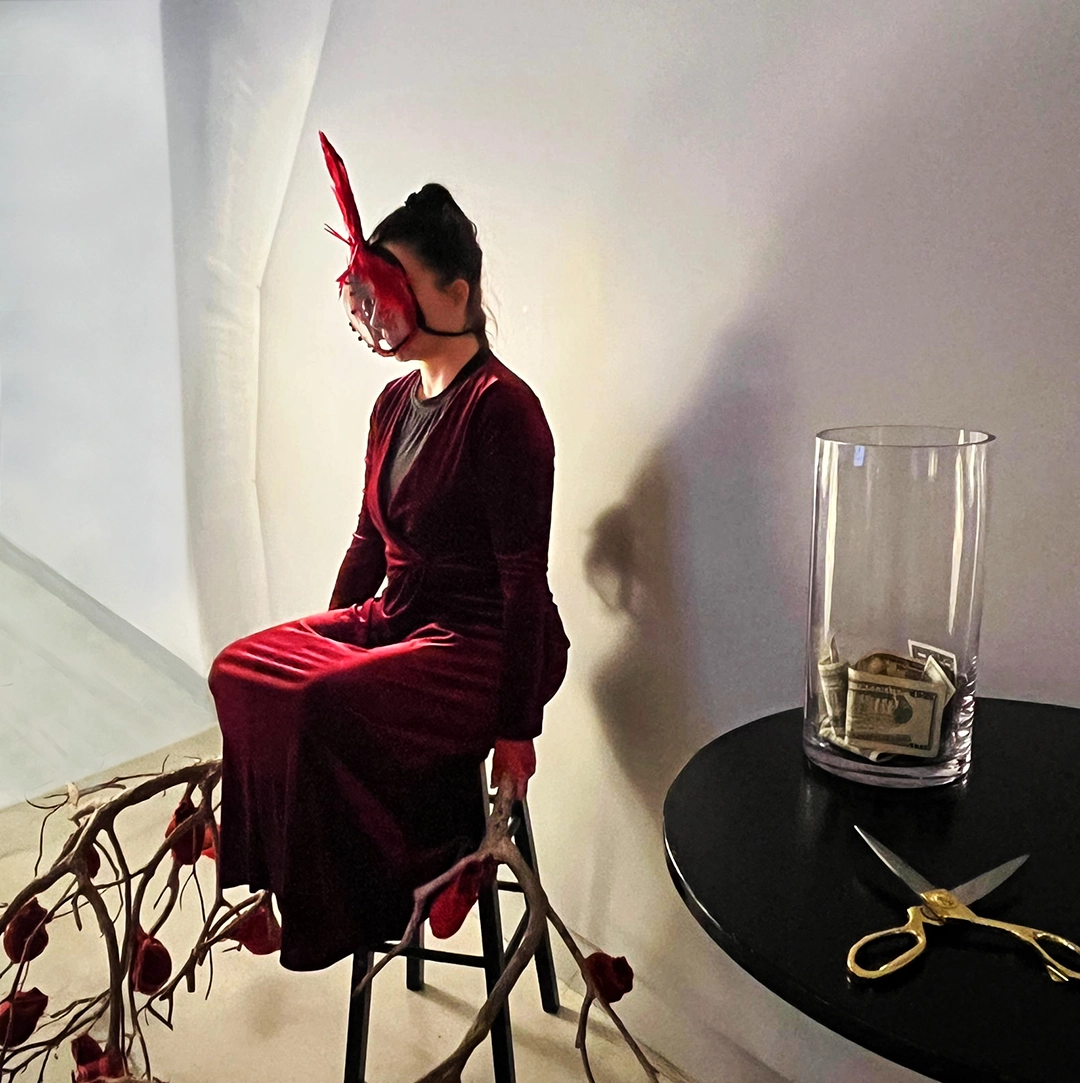
What Price Would You Put on My Heart (Performance)
Documentary Photograph
The choice of the dress is not trivial. It implies a taking of sides. The design, the color of the fabric, the very texture of the cloth converse not only with Moreira’s previous series.
If creation is a continuous process of observation, search, associations—of discoveries and defeats—even when one has left behind the studio, the gallery, the workshop, or the room where work takes place, then art “unfolds” like a procession, or rather like critical thought wherever the artist happens to go.
As if that were not enough, the artist is asked—or gently nudged—to become the entrepreneur of her own work. Seen this way, there would be no isolated moment in which art is not being made, and where the enterprise and the “brand” are not simultaneously at play.
Is the red dress a sort of campaign uniform in the new “theater of operations” that exile in the United States has become for Moreira?
Within the complex universe of relationships, competition, (new) affections and (old) betrayals, the dress stands as the last frontier between her body and environment.
To understand and extend the performance even where retreat, surrender, or silence is demanded of her.
That dress speaks for her. Does it also speak for us? Does Cirenaica speak for you and for me?
According to Moreira, the texts she has been conceiving are themselves her new performative proposal.
Let us suppose that the dress has indeed served as a second skin—one with which she has not so much camouflaged herself as inhabited, through art, the adversities of exile.
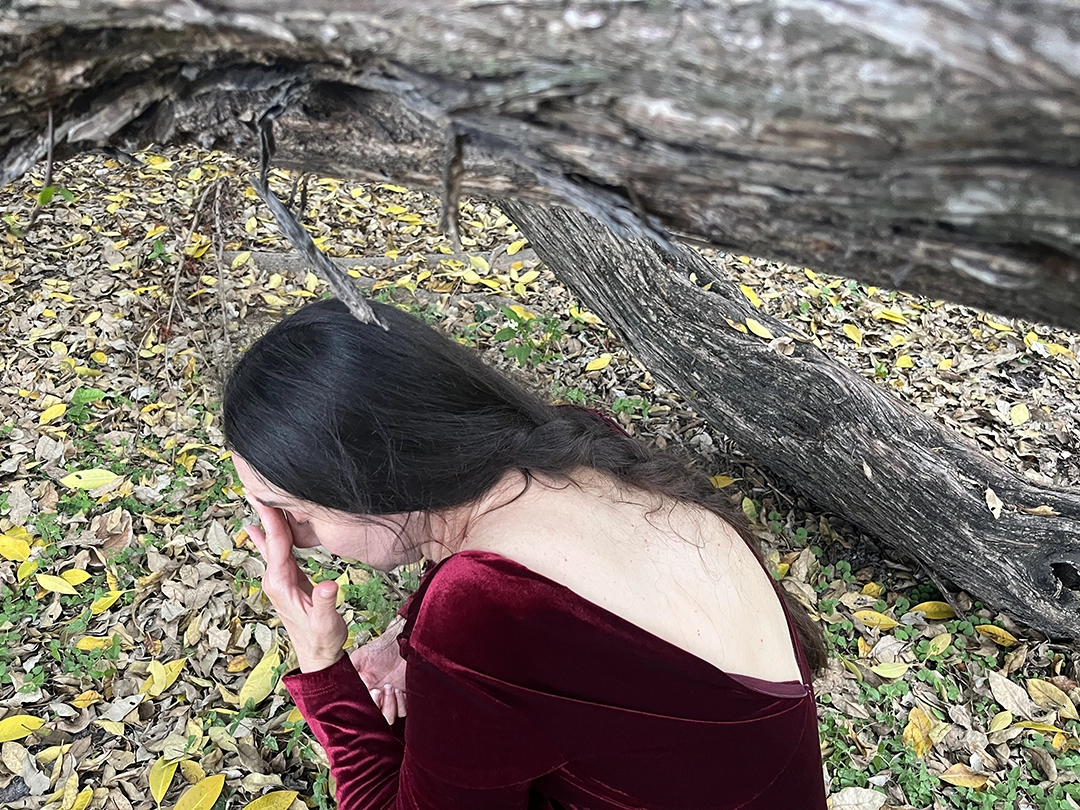
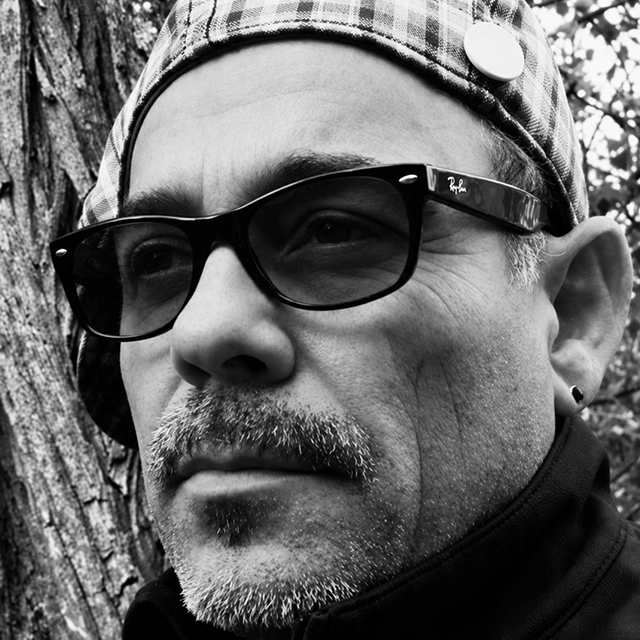
Portrait by Ahmel Echevarría.
Yes, adversity understood as precariousness, deep sadness, fragility, desperation, lack of faith, depression, weariness.
The dress came into her hands as part of a donation: second-hand clothes. Garments worn by other migrants. An enormous bundle that Cirenaica might reconvert into outfits for her photographs—that is, to use them in those scenarios or scenes she recreates and through which she inserts, within the context of the Real, her own notion of the world, her “discomfort,” her “resistance.”
A resistance that does not derive in slogans, answers, or psalms, but rather in a collective question—at least, that is how I read it.
As if dressed in order to interrogate, from a precarious equanimity and from silence, the settings of her photographs are no longer the rooms or exteriors of a house in Havana. Any fragment of Miami, or Miami Beach, or the living room of an apartment turned into a bedroom has become the ideal space in which to record, in photographs and videos, the price of being lost in a translation and relocation of life: from Havana (Cuba) to Florida (United States).
There is no living or dead lingua franca exact enough to describe, in a single seizure of (in)sanity, the variations and degradations of migration or exile. There are loves that kill—or, which amounts to the same thing, there are pacts that collapse and devastate both mind and body wherever they may come from. They occur swiftly and brutally. They burst forth wrapped in the décor of decency, supposed friendship or loyalty, the extended hand that appears willing to help or to become an empathetic subject precisely when the migrant is most fragile and completely fucked.
Faced with constant fragility and beating, dressing in long red garments with the intention of fixing, in the passerby’s retina, a glamour that seems to carry the patina of hauteur—also of illness, or of sorrow borne with effort.
The dress possesses a design that turns Moreira into a transtemporal subject.
It seems to gather in her body the battles and defeats of not a few women, as if she were embodying those lives.
Cirenaica as a trans-corporeal subject?
Let us move to a long enumeration.
Dressed in long red at the Miami International Book Fair.
Dressed in long red on the dunes of North Miami Beach.
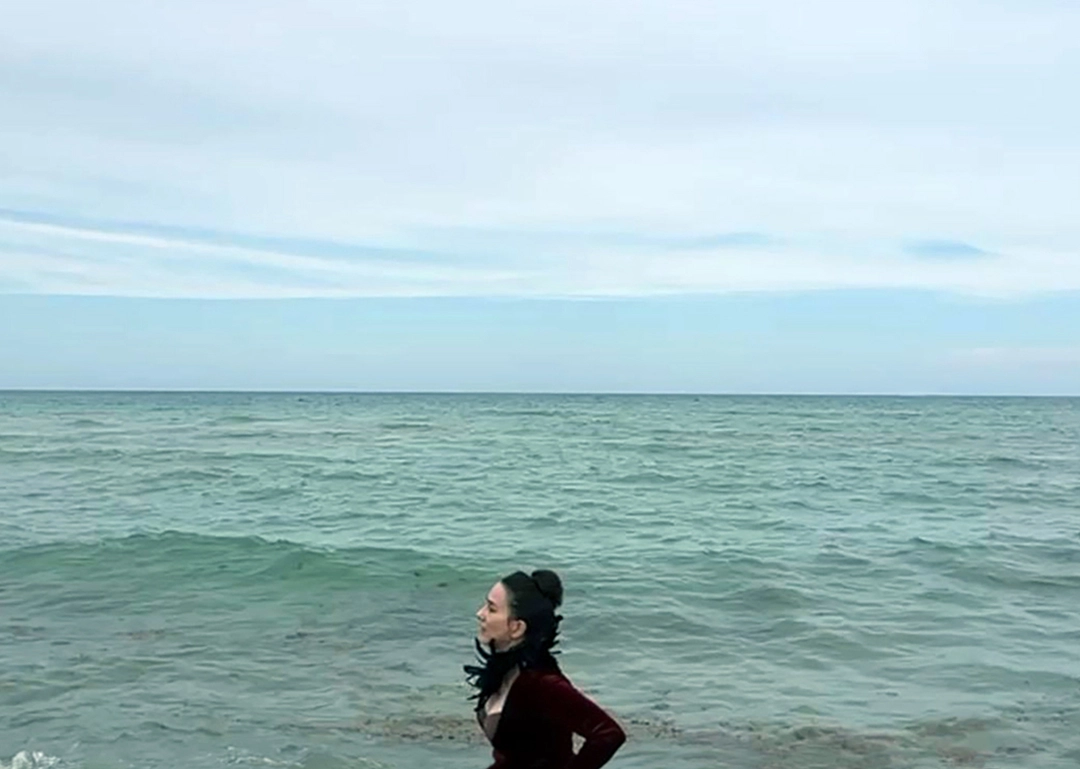
From the Vitiated Actions Devoid of Meaning Series, Untitled, 2025 (Video Still)
With the water reaching the edge of the broad neckline in the nearly wild sea that breaks again and again against the sands framed between 71st and 73rd Street.
Crouched beneath the trunk of trees almost lying across the grass of a park in Normandy Isles.
Or producing a sharp contrast within the improbable, low foliage of a cluster of casuarinas.
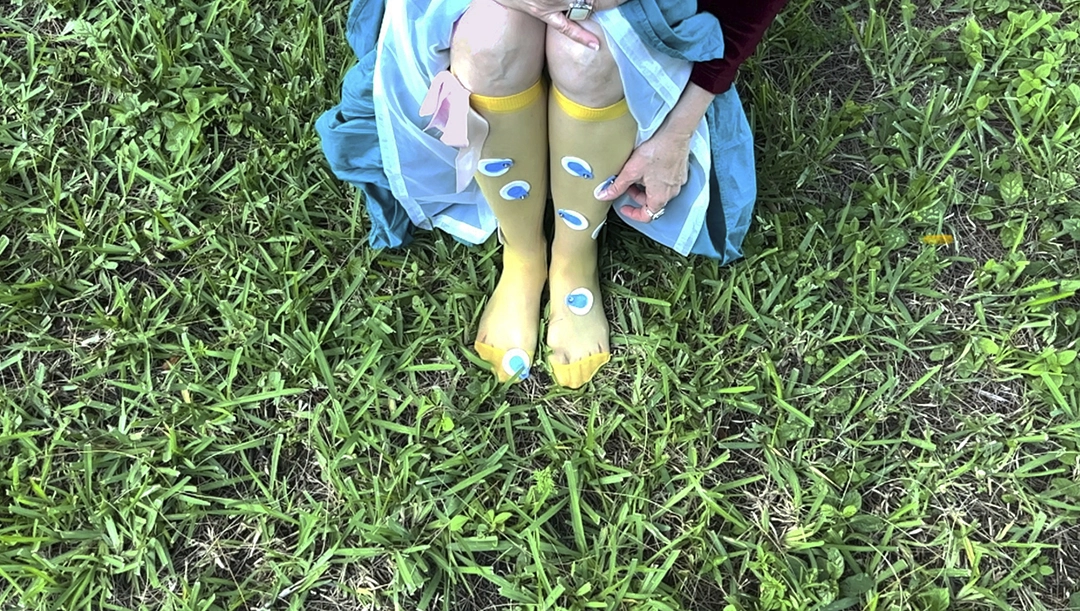
Cirenaica, with the hem of the dress above her knees, displays those suction cups which, instead of being fixed to the chest to record the altered lines of a half-wrecked heart, she has attached to her legs. Is she attempting to reveal the turmoil and intensity of a decision, along with its causes and its agents? Is she trying to describe with precision a flight, a struggle, a collapse?
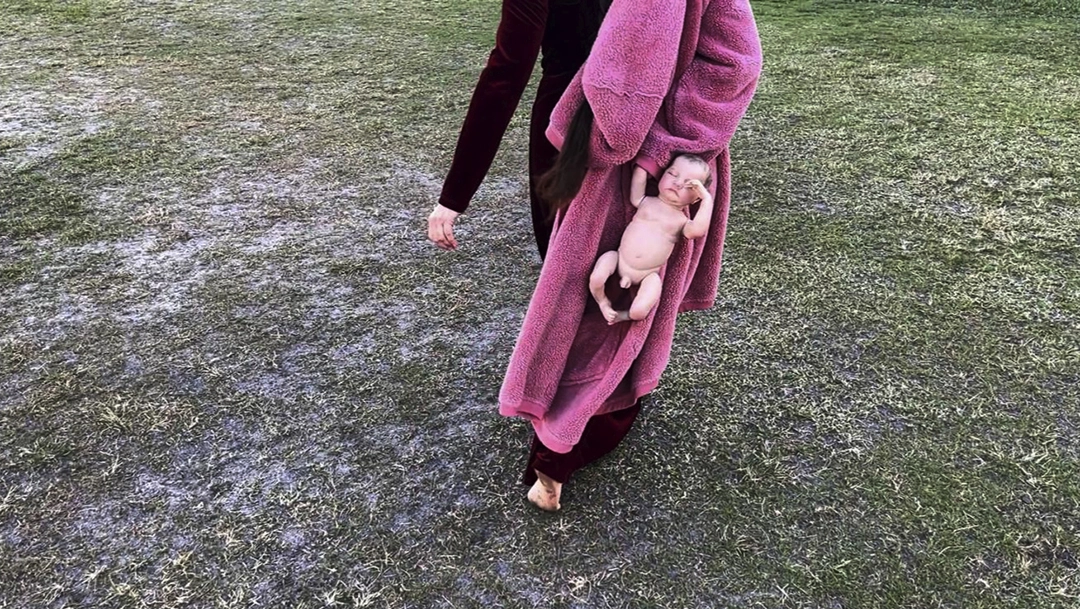
From the Vitiated Actions Devoid of Meaning Series, Untitled, 2025 (Video Still)
Moreira is the woman advancing slowly across a lawn that tends toward infinity. She drags with her a baby. The child has been taken by the arm, hanging there, as if rescued from some unspeakable event.
Let us put an end to the enumeration before recording—using the artist’s own words—that we are dealing with videos and photographs that serve a double purpose: “video memory” and “video art.” The first, in the manner of a making-of, registers life and destiny and could become a work of art. For the moment I would dare call them “pages of a diary,” the book Cirenaica is writing—a sort of “arduous diary.”
The photographs and videos possess a facture attuned to the transit almost every immigrant undergoes. They ooze—or appear to ooze—haste and precariousness. They reveal the absence of a domestic space and the lack of adequate resources for the recreation of scenes. Yet from that single small room she has fashioned a multiple space.
Executed with an iPhone, the reduced dpi record with precision what boils in Moreira’s head, what has been seized by dream, what can only be vomited in the form of an autofiction essay dovetailed with photographs and videos.
But those few dpi do not permit the generation of a file that can be printed at large scale.
Dpi—dots per inch—might here mean something else entirely: downsampled personal image. Are we witnessing a turning point in Cirenaica’s work, where we must also include other images in which she is not dressed in long red, yet which harbor that same anguish or plural desire?
These “uncomfortable pages” of her diary contain questions almost imperceptible, like the spines of certain cacti or pods—the kind that lodge themselves in your fingers. You can remove them only by rubbing your hands through your hair. They will remain tangled there until a good dose of soap and abundant water washes them away.
By deliberately distancing herself from a Canon or Nikon camera, she has positioned herself within the canon dictated by low-budget productions. Yes: the dpi of Cirenaica Moreira.
There is no way she goes unnoticed wherever she appears dressed in red, dressed as if to interrogate. Many turn their heads. Not a few watch her pass. Some go further and compliment the outfit.
With a necklace of black rooster feathers, or a red scarf trailing like a cat’s tail, that red dress—perhaps a second skin, perhaps the body’s final frontier—is a variant of animal print: the hide of a beast not so much mythical as multiple.
It is the lycanthropic power of someone struggling to resist, to survive, to leave the uncomfortable record of a battle that not a few had already declared lost.
* This text forms part of the book in progress Miami Grand Prix, a project that received one of the resilience grants awarded by Artists at Risk in 2026.

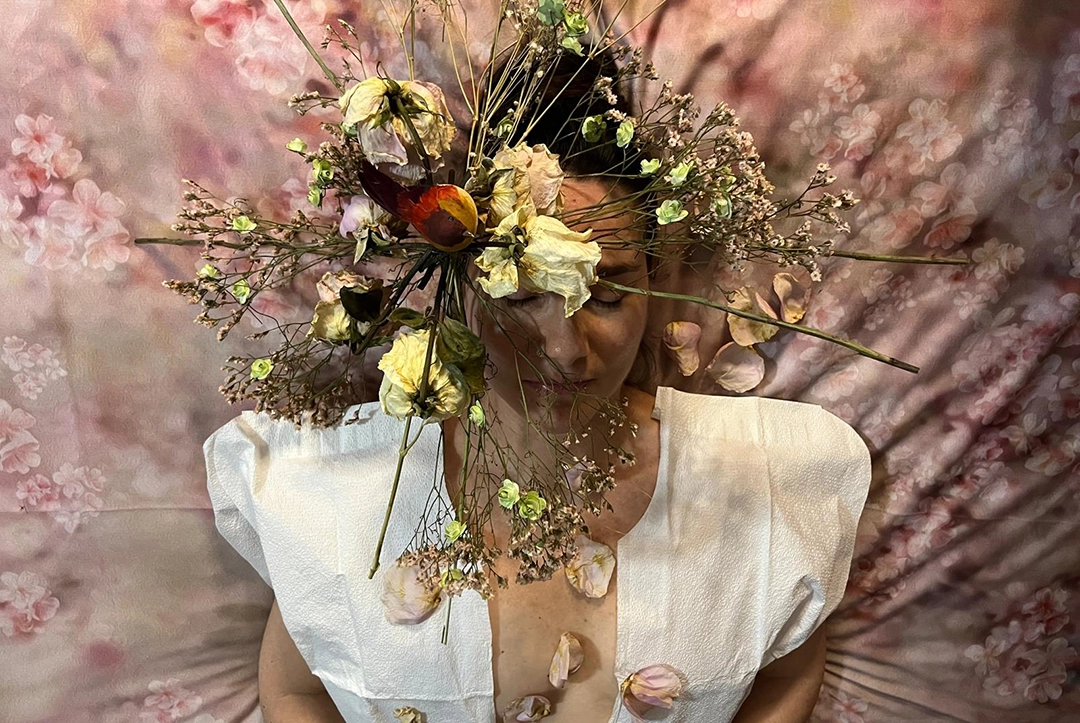
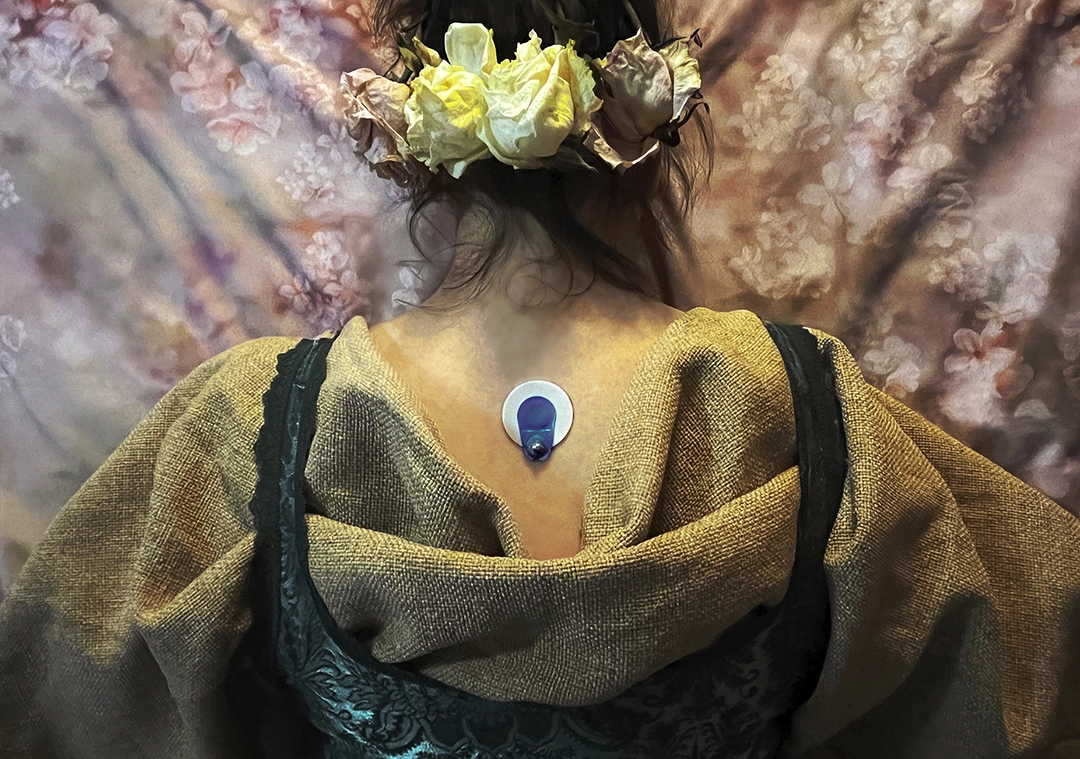
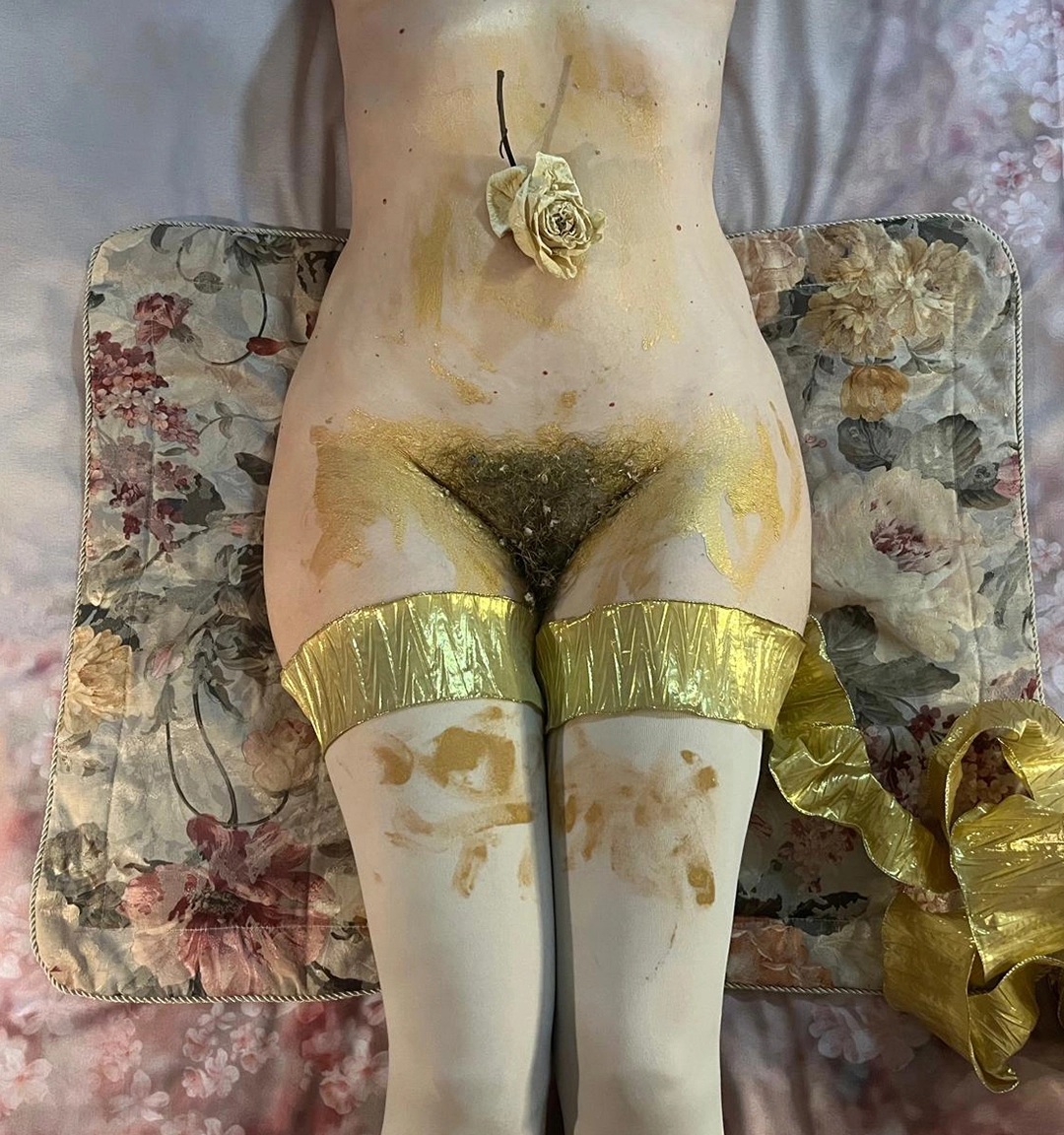
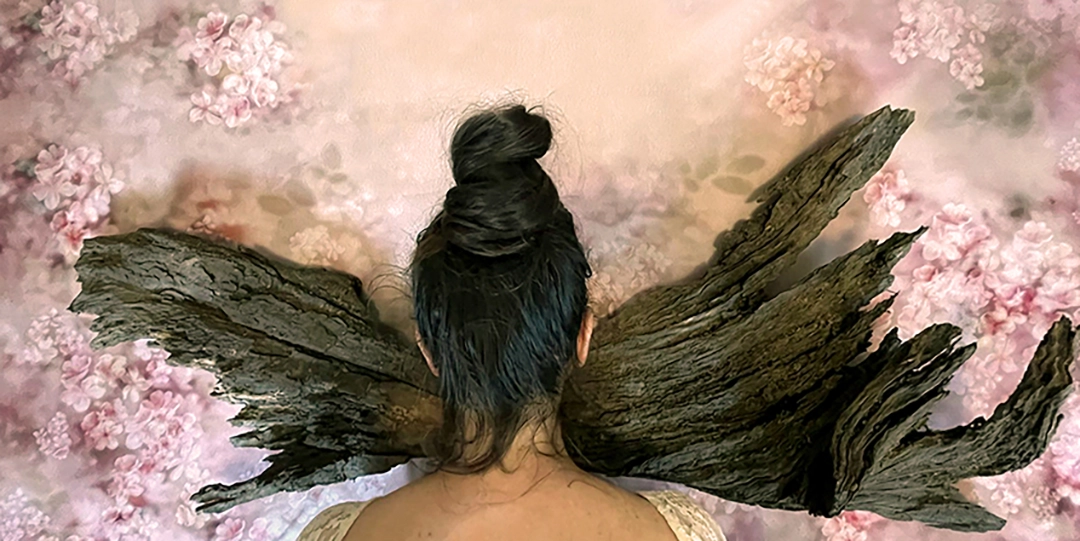



I have sometimes thought about what, for once, I might call “the oneiric substance,” if only to steer the question into less sinister territory: do dreams arise from experiences not fully processed, or are they autonomous energetic structures, detached from various material or temporal sources, that pass through the mind in search of the lost warmth of emotions? The question has its beauty.
Evelyn Sosa and Leticia Sánchez Honored for Their Artistic Contributions
.svg)