1310 PENDLETON STREET CINCINNATI, OH
| (513) 407-7077 | WED - SAT 11:30 AM - 4:00 PM

THE
ANNEX
NEWS

Two works from Leticia Sánchez Toledo’s exhibition remain in Cincinnati.
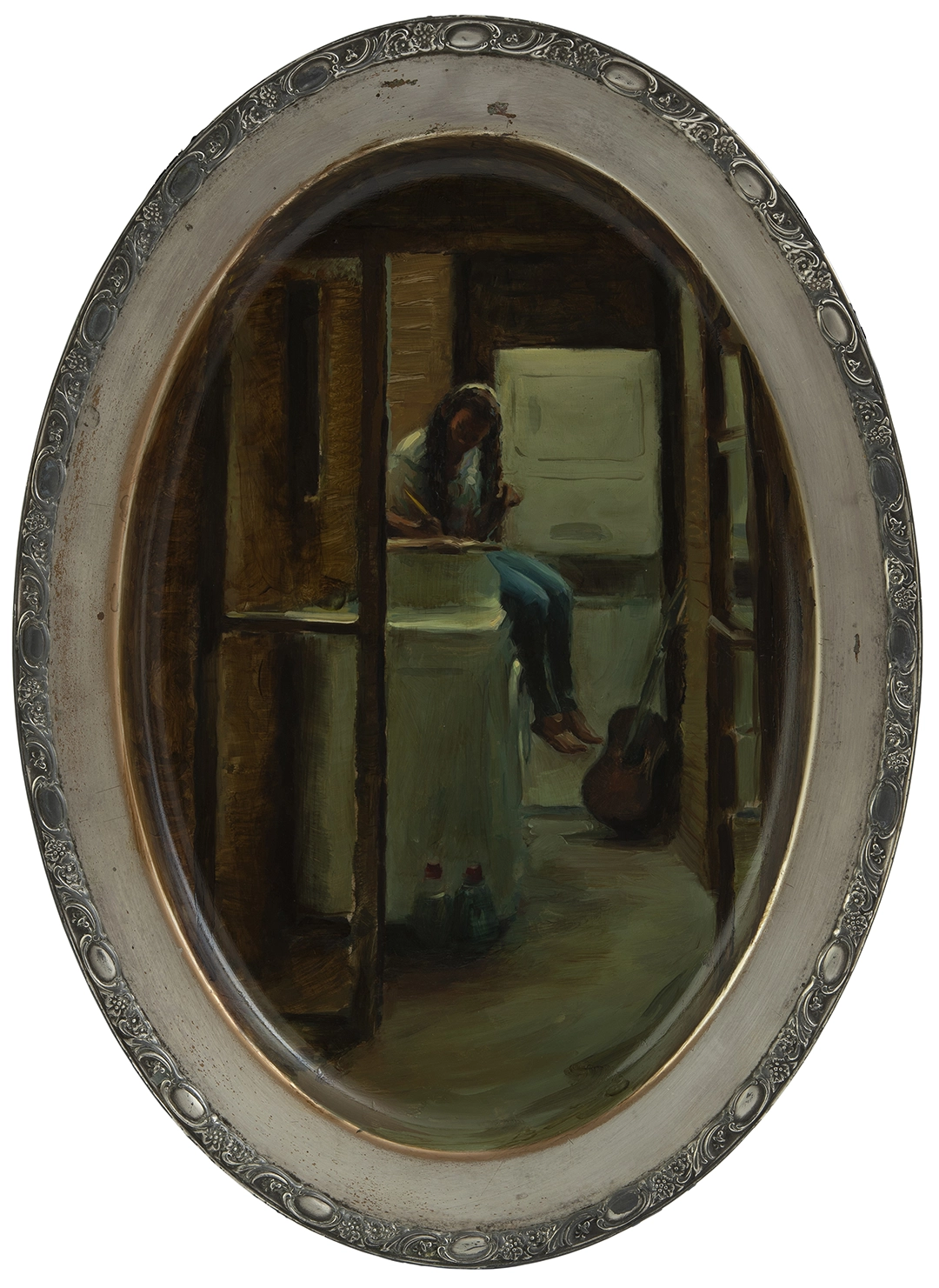
Two of the works from Leticia Sánchez Toledo’s recently closed exhibition at Annex Gallery will remain in Cincinnati. Offering an additional reading is hardly gratuitous, especially one that places them, for the local audience, within a more precise context. Works produced by emigrants seldom rest on purely aesthetic assumptions. Uprooting leaves deep injuries. They appear to heal, yet their scars continue to organize memory, affection, and the way everyday life is accepted.
Across the body of work exhibited, the migratory experience does not appear as a frontal narrative or as an emphatic declaration. It is held inside an economy of almost imperceptible gestures, detached from any fixed anecdotal account. Seen from a certain angle, or under a lateral light, these scenes allow us to recognize a practical, silent, almost domestic form of adaptation. The work acquires its density when that practical reorganization of life finds a visible form.
The work that opens this text is a piece on a metal tray from the series Docile Metals and Memory. Among the qualities proposed by the support itself — perceptual, visual, tactile — memory prevails.
Anyone who emigrates from a poor Caribbean country, from Cuba, almost always faces the same repertoire of difficulties in managing daily life. The first rooms one rents rarely include a washer and dryer, so women, often enough, carry their clothes to the laundromats scattered through the neighborhood. The service devours hours. Little remains to be done while the cycles run.
That dead time demands some use, some form of occupation. But what kind of creation can fit inside such an environment? Painting seems unlikely. Drawing, perhaps. Writing in a notebook, yes, because it requires almost no space. The guitar leaning beside the machines does not argue for an epic resistance, nor for the resilient attitude — the sort of thing one says in order to move on quickly. I believe it appears as a practical possibility, as an available object, something that can accompany the wait or be taken up again when the noise allows it.
From that suspended time emerges the minimal substance of creation. A young woman bends over and writes. The instrument, provisionally abandoned, waits for its moment. The imagination is exercised at the margins of waiting.
After the wait — probably one of seven years — the metal becomes a receptive surface. The tray accepts the painting and turns a limited scene into visible memory, incontestably worthy.
The subject is creative precariousness, the barriers that poverty and economic imbalance place before creation. Barriers that begin in the country left behind and continue, for a considerable stretch, under new circumstances.
A first and distracted glance will not reveal the gray hours of the laundromat, the rented rooms, the accumulated laundry, the waiting. We will find an object that is, without question, quite beautiful and delicately made. And if we take a step back and observe the work on the gallery wall, another reading becomes possible. A concluding one is that restrictive experience, worked through with constancy and decision, becomes delicate form.
These are years of attention condensed into a single image. Faced with a life made of provisional spaces — the rented room, the shared machine, the waiting hour — the tray remains. Now beyond Leticia Sánchez Toledo’s hands, the piece will outlive the scene it contains, the anguish that may have provoked it, the harsh present of us all, and probably its own time.
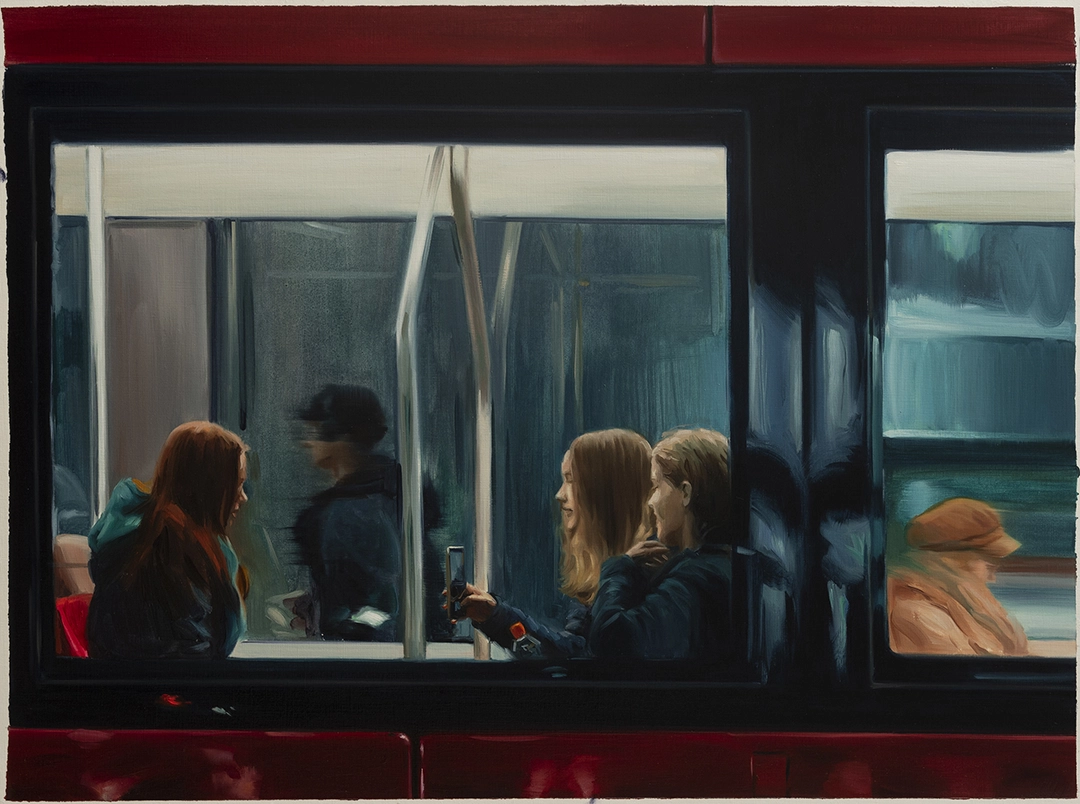
Study for Friday Night, 2024
Oil on paper, 18 × 24 inches
About two years ago, Leticia often moved through some of Miami’s most crowded areas, especially those where the city leans toward the beach. Congested sidewalks, places of leisure; bus stops above all, at the hour when the city tips toward the weekend. She comes back with whatever she could see. This piece gathers one of those views.
A red bus, halted for an instant, about to break its inertia, observed from outside, through the glass.
The structure of the vehicle and the glass parcel the scene into panels, like a frame of negative film. On the left, a copper-haired young woman looks on in profile. Outside, on the next plane, a dark body advances and comes undone in its own motion. A chrome pole cuts the composition in half —an axis that separates; the partitioning of the field recurs across nearly all of Leticia's work— and absorbs the cold light of the interior. Toward the right, two figures lean toward each other. One of them repeats Leticia's gesture, raising her phone to hold on to very nearly the same instant. Farther on, in the next panel, an orange coat seen from behind fades, on the verge of becoming a reflection. On a Friday night already beginning to slip away, Leticia watches from the sidewalk others who, on the far side of the glass, are also constructing a gaze.
This is the elementary description of any image at all. We come across them every day. They tell us what we see. How red the red is, the green so greenish, the denatured yellow. Not always the essential thing, which here, and in my own opinion, is the study that occupies Leticia —the multiplicity of existential planes.
Although her image holds the interior of a bus, the reflections of the outside, and the bodies that cross without stopping, what overflows it is its symbolic content. For from that more attentive vantage the concepts of 'being inside' and 'being outside' emerge, realities that a mere pane of glass separates, as do the conditioning forces of each of those realities.
If anything fascinates me in this image, it is the impossibility of telling whether Leticia is an outside observer or embodies one of the passengers. Both readings are perfectly possible. I lean toward a diluted documentary intention. Not because it deliberately describes a univocal reality, but because each of the figures carries a reality of its own, a private tragedy or a joy. For these are states that can coexist perfectly well in a confined space, in a single instant. The piece reveals three young women who seem bound together around some gratifying experience. And it is precisely for that reason that I distrust their authority within the composition. Too obvious. Two figures in flight also appear, taking no part in the communal warmth, seeming to flee what is luminous. They appear, what is more, blurred by movement. It is also possible that the subject of a symbolic sentence is not the one we take to be the protagonist at first glance. It may be a detail the artist offers to those who grant it two or three looks, a little attention, and the capacity to notice it. This need not necessarily be the case. I allow myself only the doubt —or the reverie.
In any case, the fact is that our realities unfold in zones bounded by glass, barriers, and mirrors. We have stood before many shop windows that protect —while flaunting— what we cannot afford. Toys, jewels, sophisticated equipment. On the street we watch the luxury cars go by, the life that moves beyond our reach. The one we imagine, the ones we will never see.
On the other hand, one of our most precious possessions is the space we call personal, the intimate one. The one that shrinks drastically on public transport, where the certainty that we are merely one more grows heavier.
Leticia's piece, Study for Friday Night, strikes me as a tunnel of mirrors. A chain of reflections that contain one another to infinity. Our subjectivity, confronted, set against that of the other, physically ricochets, amalgamates into a disconcerting and almost overpowering image. The planes multiply and we lose all sense of space.
Where are we, to what do we belong, who are we, on which side of the glass do we find ourselves? It is enough to step out onto the street any Friday, at night, to peer into the first mirror, to fall into a kaleidoscope where our identity is interpellated and where our composure suffers before the question. Art long ago revalued the marginal, the peripheral, the antagonistic-by-exclusion... At times it resurfaces, camouflaged among dazzling signs, to remind us that beyond the apparential, everything has two faces.





Given its scale and significance, I will present my analysis of this project in several installments. These are the ten design proposals shortlisted for the next series of euro banknotes. At this moment, they are under the gaze of millions. Citizens of the euro area have been invited to choose their favorites in a survey that will remain open until September 21...
2026 FotoFocus Biennial



2026 Members’ Exhibition
.svg)
