1310 PENDLETON STREET CINCINNATI, OH
| (513) 407-7077 | WED - SAT 11:30 AM - 4:00 PM

THE
ANNEX
NEWS

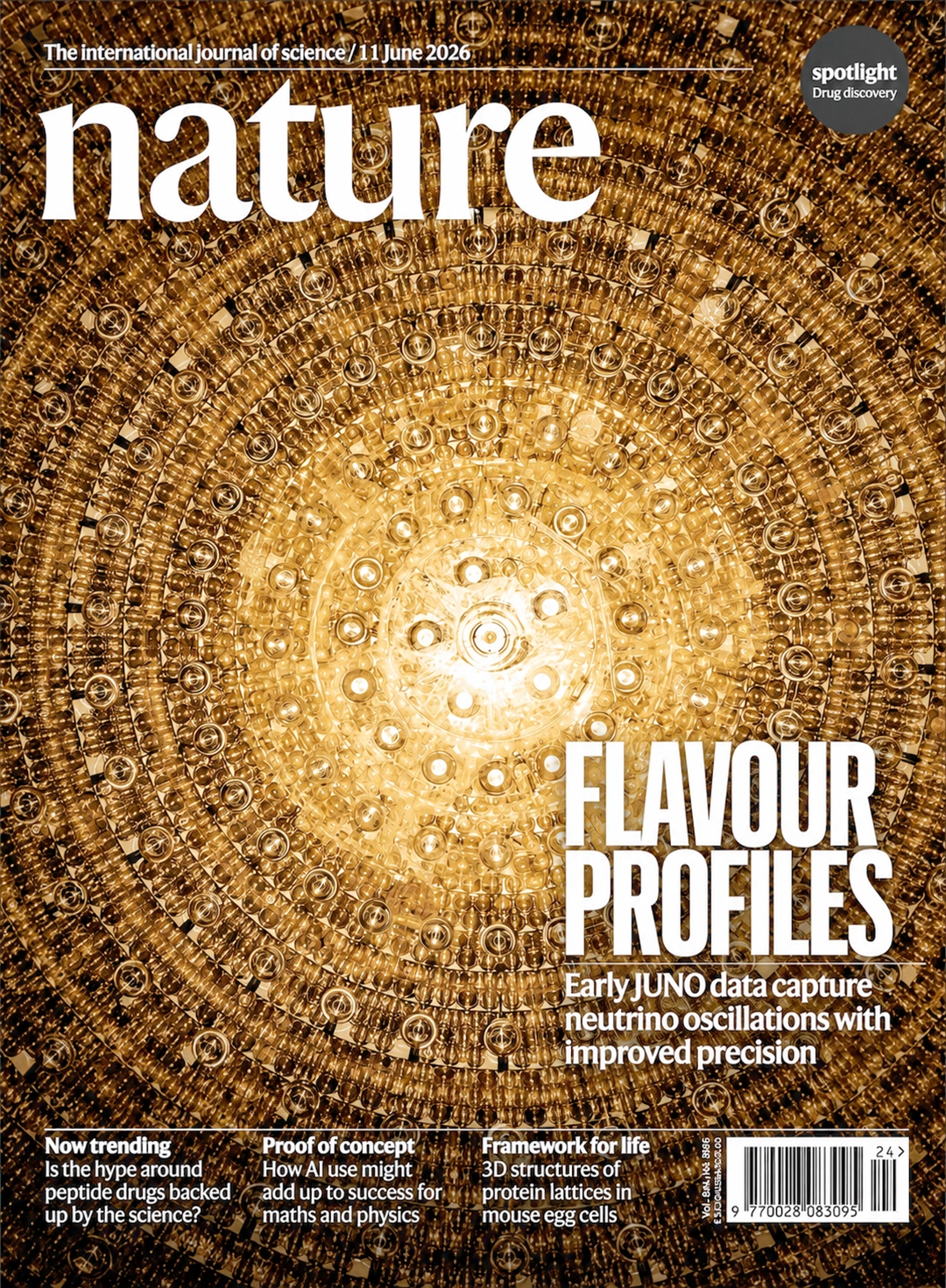
Nature Volume 654 Issue 8118, June 11, 2026
A few days ago, I wrote about the photograph that received first prize in the Nature Careers Working Scientist Photo Competition. The competition is intended for researchers, students, and people working in science. They were asked to stake everything on a single horse: one photograph of their own work. In the laboratory, in the field, among instruments and samples, on an expedition, within the sometimes precarious intimacy of a research team at work.
Its rules exclude anyone who earns more than a quarter of their income through the sale of photographs. The aim is to preserve the scientific gaze over strictly aesthetic—editorial, if one prefers—values, the kind Nature’s editorial machinery might otherwise demand. What the competition seeks is a scene capable of condensing a method, a journey, or an entire investigation into a form that is immediately visible, persuasive, ready to circulate.
The awards appeared in the June 11, 2026 issue, volume 654, number 8118, in the Work section. The article was titled Five Winning Images of Scientists at Work and brought together the five selected photographs, including Gunnar Hartmann’s, the protagonist of the article mentioned earlier.
Nature had too many other matters on its mind to place the competition on the cover. That issue was devoted to the JUNO neutrino observatory, under the title Flavour Profiles, with an image of the interior of Guangdong’s monolithic spherical detector. Hartmann’s photograph and the other winning images appeared in the Work section.
Some of them appeal to me more than others. None very much. Still, it would seem unfair to leave the work of the remaining winners uncommented upon.
The accompanying texts have been taken verbatim from an article by Alexis Austin, published in Nature’s online edition on June 10, 2026.
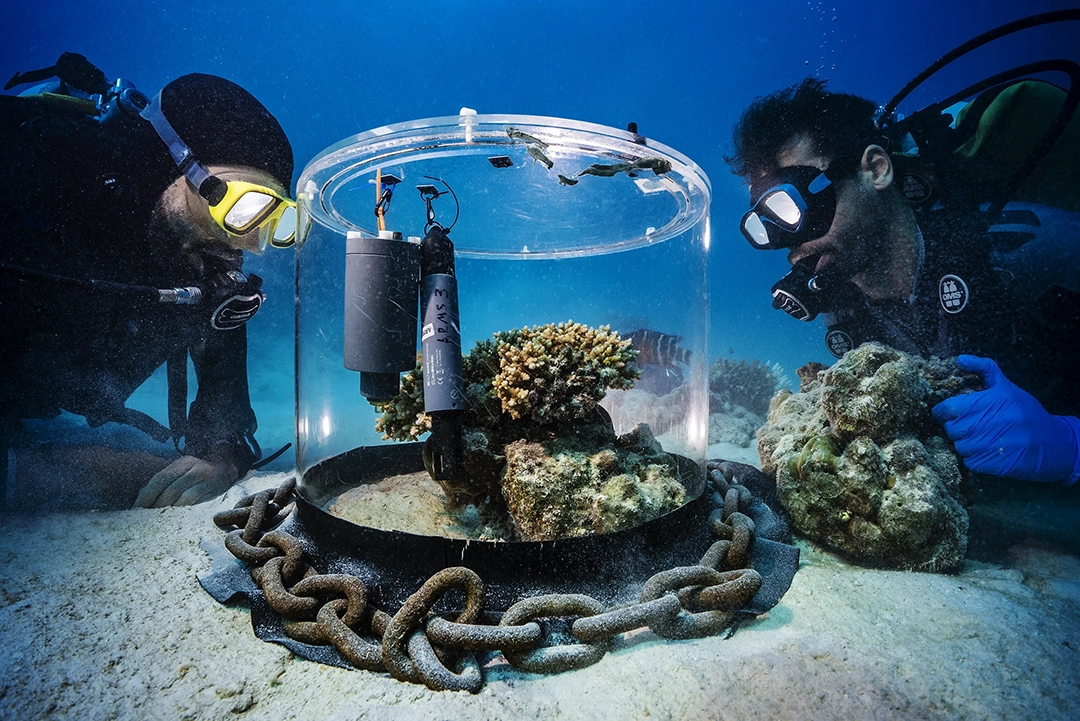
Under the sea, by Florian Huber
Under the sea by Florian Huber
Deep in the Red Sea off the Saudi Arabian coast, Nauras Daraghmeh (left) and Yusuf El-Khaled install an incubation chamber over part of one of the region’s precious underwater ecosystems — a coral-reef community. Nearby, freelance marine biologist Uli Kunz captures the delicate scene on film.
Nicknamed the 'coral probiotics village', the project, based at King Abdullah University of Science and Technology in Thuwal, Saudi Arabia, aims to investigate how different corals — such as Acropora species pictured here — are adapting to the rising water temperatures caused by climate change.
The chambers allow the researchers to study how the ecosystem functions by measuring the amount of oxygen consumed and produced by the corals and their symbiotic zooxanthellae — microscopic algae that live in their tissue and that of other marine species.
'In this photo, I wanted not only to capture the research divers in the midst of their often hectic work, but also to show a moment of quiet contemplation,' says Kunz.
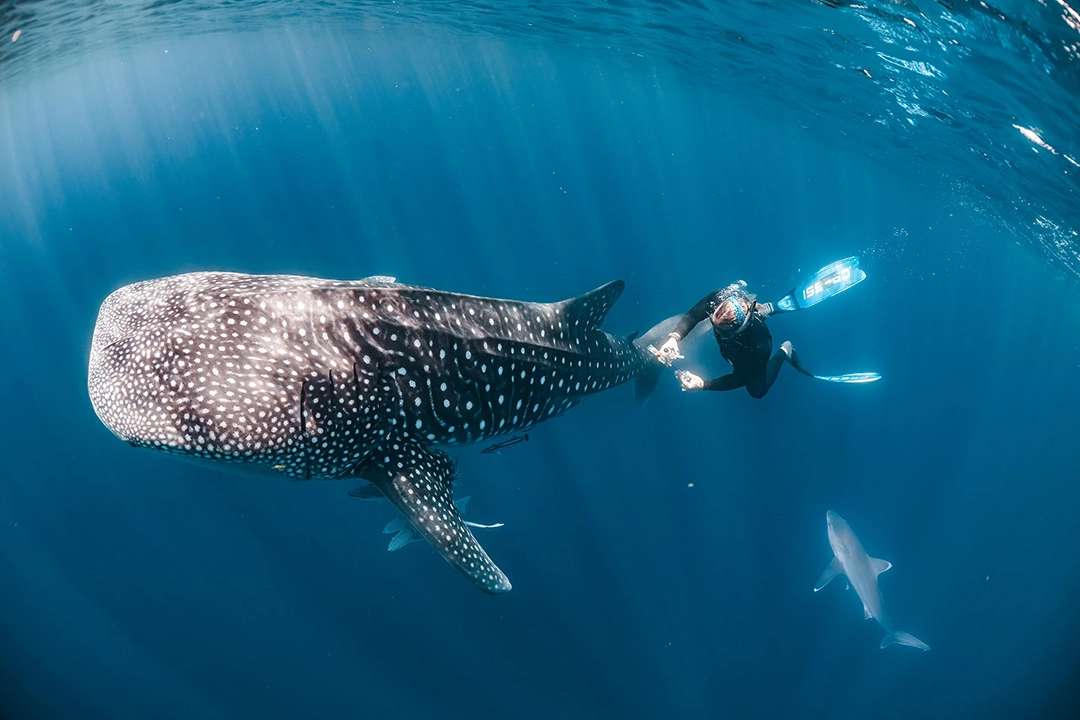
Protecting gentle giants, by Rob Harcourt
Protecting gentle giants by Rob Harcourt
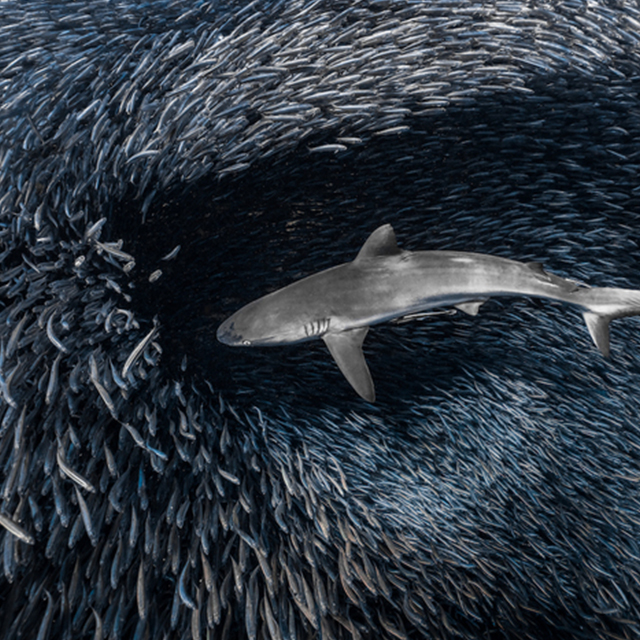
Diving down on a single breath, marine biologist Michael Doane carefully skims the skin of a whale shark (Rhincodon typus) with a syringe, collecting a sample of the microorganisms that dwell there. Behind him, a curious silvertip shark (Carcharhinus albimarginatus) swims into view.
This image was taken in April at Ningaloo Reef off the coast of Western Australia by Robert Harcourt, a marine ecologist at Australia’s Macquarie University in Sydney, who was on hand to document the event.
'Swimming next to a 12-metre whale shark as it cruises through the blue, gulping away and seemingly non-plussed by our presence is both humbling and exhilarating,' says Harcourt. 'The silvertip shark sneaking up on Mike got all our hearts racing — except Mike, who was focused on microbes,' he says, adding it was a reminder that the moment was 'unfolding within a broader, interconnected marine community'.
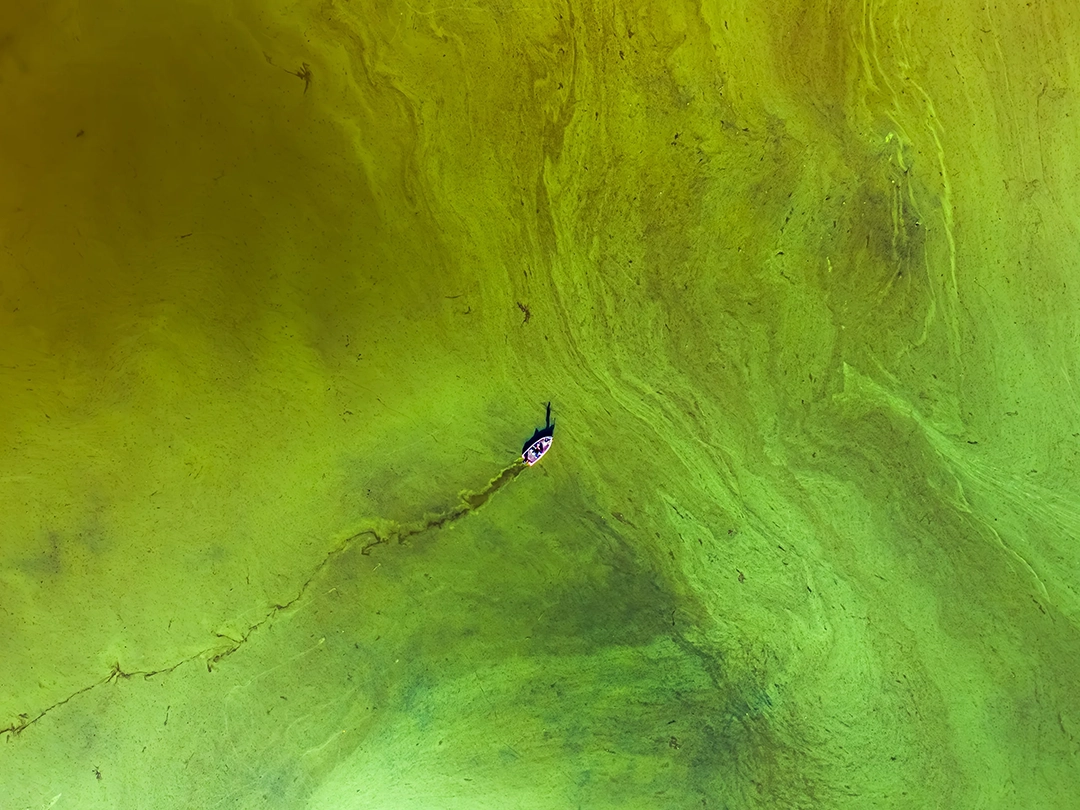
Standing against the bloom, by Haolun 'Allen' Tian
Standing against the bloom by Haolun (Allen) Tian
From the sky, the algal blooms on Dog Lake in Ontario, Canada, look like abstract art, swirling as creatures and objects pass by. But from a boat, it’s a different reality.
Microcystis aeruginosa and Dolichospermum flos-aquae — two algal species common to Canada — create a 'toxic, vile smelling layer of rot' on the lake each summer, according to Haolun ‘Allen’ Tian, a PhD student at Queen’s University in Kingston, Canada. The thick green bloom kills fish and clogs water supplies.
'During the fall, they actually rot and die,' Tian adds. 'Basically, there’s very few species that can eat them, so they don’t enter the food web.'
In the morning light of September 2021, the silhouette of Queen’s University master’s student Kelly Estrada Piedrahita stands out against the green as she collects water samples from the front of the boat. Behind her sits volunteer Shirley French, while Tian — the project’s lead — takes photos from the shore.
After collecting water samples from the lake, the team filters them and extracts and analyses the environmental DNA (eDNA). 'eDNA techniques are extremely sensitive and allow us to detect even just a few copies of DNA from species of interest,' says Tian. Using this information, they can then investigate how the algae interact with other lake species.
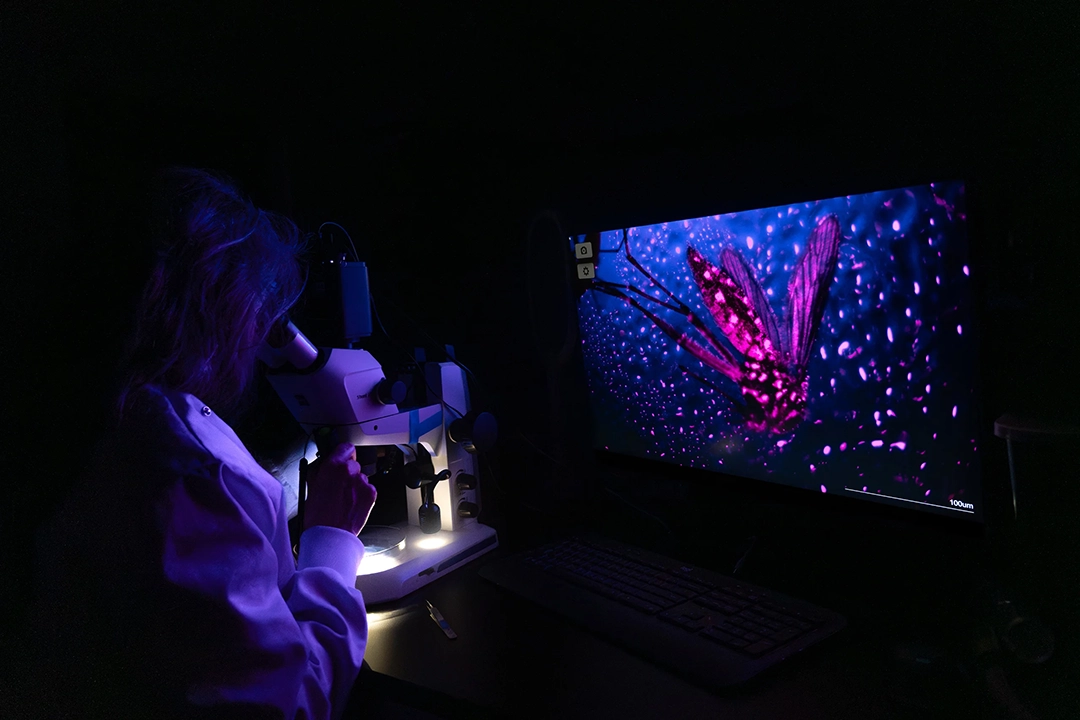
Captured in the glow, by Shayanta Chowdhury
Captured in the glow by Shayanta Chowdhury
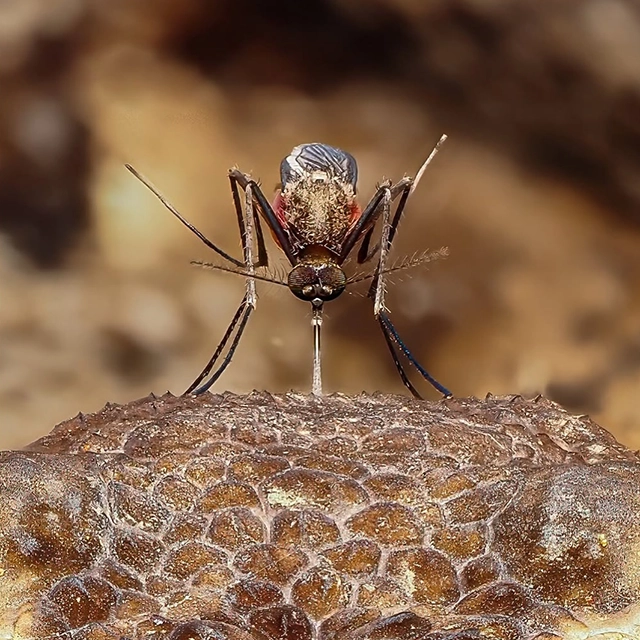
Under ultraviolet light, the yellow fever mosquito (Aedes aegypti) in Lee Haines’s microscope glows bright: a sign that it has fed on a sugar concoction spiked with a fluorescent dye and a mosquito-killing agent. Haines, an entomologist at the University of Notre Dame in Indiana, is part of a team studying how the drug nitisinone can be used to kill blood-feeding insects.
'The UV illumination created striking colours from both the tiny mosquito and the condensation that formed beneath the cold Petri dish,' says photographer Shayanta Chowdhury.
As a chemistry PhD student at Notre Dame, Chowdhury uses lasers and spectrometers to study molecules attached to nanoparticles. Although 'I don’t work with biological samples,' he says, 'I am always fascinated by their beauty under the microscope.'




Given its scale and significance, I will present my analysis of this project in several installments. These are the ten design proposals shortlisted for the next series of euro banknotes. At this moment, they are under the gaze of millions. Citizens of the euro area have been invited to choose their favorites in a survey that will remain open until September 21...
PRESENTED AS PART OF THE 2026 FOTOFOCUS BIENNIAL: THE LONG VIEW
.svg)