1310 PENDLETON STREET CINCINNATI, OH
| (513) 407-7077 | WED - SAT 11:30 AM - 4:00 PM

THE
ANNEX
NEWS

Introduction
The following interview was published by Hypermedia Magazine on July 9, 2019, as part of its section “The Forms of Violence.” Today, with Juan-Sí’s explicit authorization—and, presumably, that of its author, who died in Havana a few years ago—we reproduce it in the Annex News Section on the occasion of his exhibition I.T.I.N.E.R.A.T.I.O.N.S. at The Annex Gallery.
Juan-Sí González, or the Horizon of Orphanhood
July 9, 2019 | By Héctor Antón
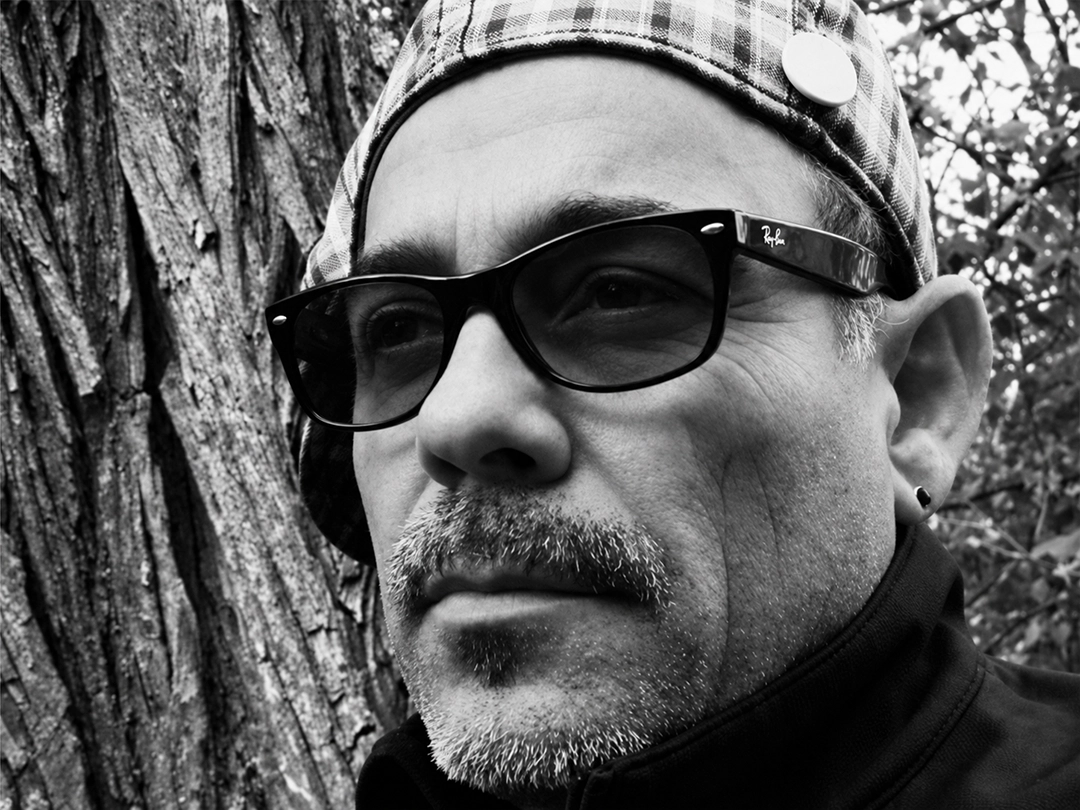
Juan-Sí González (Santiago de Cuba, 1959) grew up, and survives, with the longing to fuse life and art. Throughout his pilgrimage, he has maintained the profile of a multidisciplinary artist always ready to turn his hand to different trades. A kind of globetrotter moving beyond the centers of the mainstream. Along this path, he now works as a delivery driver, seeking inspiration while devouring mile after mile across North America.
His wandering reveals the course of a restlessness unwilling to yield to the passivity imposed by fear or caution. The direction of his fate took him from eastern to western Cuba, until he eventually found refuge on a continent that became his global shelter. All of it in order to prevail in a war against time, in search of a miracle: to find peace with himself.
Juan-Sí was one of the young men who arrived in the capital to study at the National Art School, located on the grounds of the former Country Club in Cubanacán. He sensed immediately that he would never return to his hometown. The dynamics of urban life seduced him. In his new habitat, he discovered the pleasure of reading as a tool of knowledge and a spiritual balm. These were the years of Nueva Trova, sugar harvests, slogans, parades, a nation in uniform.
He read Faulkner, J. D. Salinger, and Poe; through Orlando Alomá, a writer and literature professor, he learned that Dada and Surrealism had existed. Later, he sought out the clandestine literature of the time: Heberto Padilla, Guillermo Cabrera Infante, George Orwell, and Reinaldo Arenas; Borges, Cortázar, Octavio Paz. Through the haze of the fanfare, some light could still be glimpsed at the end of the tunnel.
Juan-Sí has no clear conception of violence, even though he has suffered it firsthand. For this family man now surrounded by calm, violence resembles the different forms of cancer, nearly impossible to detect or remove in time to save a life or prolong it.
Fifteen years after founding Art-De (Art and Law) with Jorge Crespo, Juan-Sí agreed to speak about political violence in the visual arts. He did so by recognizing himself in a maxim by Carl G. Jung that accompanied the poet Jorge Valls throughout the twenty years he spent imprisoned in Cuba: “I am not what happened to me. I am what I chose to be.” Juan-Sí embraced it in full awareness that to remember is to suffer again. His condition was that reality be given greater force as the foundation of fiction.
Where were you born, and under what circumstances?
“I was premature, born along the way, in transit from one place to another, between two railway stations. Between a small town on the outskirts of Guantánamo and the city of Santiago de Cuba, in the eastern part of the island. My parents were on a trip, traveling first class by train. Just as they were about to arrive at the Santiago station, my mother’s water broke and the contractions began. They put her on a stretcher and took her to the Hospital Materno Norte. That was where my existence began, inside an incubator. I spent my childhood there, until the sugar mill in town was nationalized and the authorities took over my father’s grocery store. We had to move to the home of my mother’s parents in Pinar del Río.”
Did you feel a drastic change when you moved from the countryside to the city, and later from Cuba into exile?
“Yes. It was another world, every bit as fascinating as the one I had left behind. I had spent my first nine years in San Antonio Río Seco, a little town built around a sugar mill about twenty kilometers from the city of Guantánamo. When I was around five, they nationalized that dilapidated mill and renamed it Manuel Tames Guerra, after a martyr of the Revolution who was from that region. The settlement smelled of molasses. The streets were unpaved, the houses and schools had dirt floors; I ran barefoot behind the sugarcane cars, running wild through the cane fields, cattle farms, and cockfighters’ homes.
When I arrived in the city of Pinar del Río, I saw paved streets, traffic lights, movie theaters, buildings and houses with tiled floors, electricity, telephones, television, gas stoves, running water, and toilets. I felt as though I had landed on another planet. Even under the spell of all that wonder, I missed my former life. I had to start wearing shoes and a uniform to school. I was far behind the other children. I wrote badly, could barely read, but I had lived in a way none of them had.
Exile was different. By then I was trained for it and had developed a certain detachment; I already had some ability to confront uprooting and turn it into adventure. I had left home when I was eleven and never lived with my parents again. In 1970, I entered the Provincial Art School of Pinar del Río as a boarding student. I would only go see my parents and sisters on the occasional Sunday.
I was happy during those years away from my family. They were a hindrance, and I felt they were slowing down my intellectual development. There were no books in my house, not even cookbooks. No one ever encouraged me to draw or paint. There was no music. It was a sad place.
When I told them I was going to study art, they refused. My parents, like many others, wanted their son to become a doctor. I took the entrance exams for the art school in secret. Then I asked to be admitted as a boarding student, even though the school was only two blocks from my house. I argued that my parents spent their lives shouting and arguing and that it was very difficult for me to study. I told my parents that I had been given a boarding place because I was an exemplary student.”
Did those white lies keep taking you farther away?
“I kept moving farther away from my town, from my friends, from my family, from Pinar, from Havana and, finally, from Cuba. I have lived in many cities, many countries. Guantánamo, Pinar del Río, Havana, Panama, Bogotá, Costa Rica, Miami, New York, Yellow Springs and, for the past two years, Dayton, Ohio.”
What is your concept or notion of violence?
“There is emotional and psychological violence; verbal, sexual, and gender-based violence; racial, cultural, and workplace violence. Moral, ideological, economic, and military violence. But there is also the violence of silence in the face of the violence of injustice. The violence of the Church, which, in the name of God, condones genocide, torture, and sexual abuse. The violence embraced by ‘intellectuals’ who cover up the crimes of dictators on the left or the right. Lies and propaganda are other forms of violence, regardless of which extreme they come from; they are simply instruments of control.”
And what do you think of violence as a weapon of state terrorism?
“I remember that during the public actions at the park at G and 23rd, someone handed us a VHS tape inside a paper bag, with copies of Nobody Listened and Improper Conduct. All he said was, you have to see this. We watched the documentaries that same night. I could not believe so much deliberate cruelty in the abuse of power simply because people were different and thought differently. I was still naïve, and those images of how they tried to break the integrity and will of those prisoners of conscience affected me deeply.
The lawyer and poet Jorge Valls describes how he and other inmates were taken out of their cells and led through the darkness into the prison yard. They were blindfolded and forced against the walls before a firing squad. An officer gave the orders to load, aim, and fire. The prisoners pissed and shit themselves and fell to their knees, half unconscious from the gunfire and the shock. They came back to themselves when they heard the soldiers laughing.
Years later, I had the good fortune to meet Valls in Miami and work alongside him in an office dedicated to defending human rights in Cuba. As that sensitive, intelligent, decent old man drank coffee with me, without rancor, I could not stop thinking about the images from Nobody Listened. There was no discrepancy between what he said and what he did. He is the only Cuban I have ever known who showed neither rancor nor envy. He was a spirit without blemish.”
Russian filmmaker Andrei Tarkovsky maintained that art is born outside an ill-conceived world. Did Art-De take shape through an alteration of civic-artistic logic?
“I had never thought of it that way, but yes, I think it came out of a kind of mutation generated by the bond between Jorge Crespo and me. An unusual creative brotherhood within the little art-world scene. He was a black belt in karate and a curious lawyer, a political science graduate with a great passion for art.
Jorge was always talking about international law and drawing comic strips that worked as social chronicles. I came from another world. I had just graduated from the Instituto Superior de Arte (ISA), but I shared his passion for sports; I had played baseball, boxed, practiced Kung Fu. Crespo was interested in what I could offer him through art, and I was interested in what he could teach me in legal terms. We began sharing information, ideas, strategies for taking things out into the street.
Remember, those were ‘penis-troika’ times, so we were hardly the only ones feeding that fervor. The repressive apparatus also made a substantial contribution, because its abuse kept pushing us further and further toward civic confrontation. The De… for derechos—rights—began to gain ground over the Art… for art. We became increasingly radicalized by the intensity of the repression and harassment, both inside and outside the park at G and 23rd, which was ‘our’ platform.
During the first walk we organized, An Afternoon of Sandwiches, the police detained us behind the Hotel Nacional, near La Piragua, and destroyed the signs we were wearing around our necks. Jorge and I were arrested, handcuffed, and taken to the police headquarters on Zapata. A week later, we organized another event called Plea Against Censorship (1988); that day, after a debate on censorship, the name Art-De (Art and Rights) emerged.
From that point on, we were convinced that the most important thing was not our individual artistic performances, but trying to create and defend the need for a public space for sustained encounters and debate, where we could speak and argue without the mediation of the art institution.”
Did art as retinal sabotage have to be conceived outside the gallery?
“We realized that the events themselves were the ‘piece’; our role was to make them happen every Wednesday at five in the afternoon. It seemed hypocritical to us to go on discussing art and aesthetics when control and censorship were being exercised in every corner; when the slightest act of dissent or independence was condemned; when a political or aesthetic dissident was stigmatized, fired from his job, excluded from the art world for exercising his right to his own judgment or for coming together with others. From then on, we became determined to demonstrate that the Constitution denied and contradicted the Universal Declaration of Human Rights.”
What is the most invasive act of political violence you have experienced?
“I remember one night, after that suffocating action, They’ve Screwed Up My Spirit (1988), which I performed in the park at G and 23rd. I was walking along one side of the Hotel Habana Libre, near the Route 37 bus stop. As I approached the stop, a car with a strange license plate pulled up. They opened the back door and shoved me inside. They put me in the middle of the back seat, between two plainclothes agents. The car took off, and the driver looked at me through the rearview mirror and said, ‘We’re going to take a nice drive along the coast.’ They headed toward the tunnel. As soon as we entered the darkness, they began elbowing me; one of them held a pistol against my ribs. Between the blows and the elbows, I laughed. That gun barrel against my ribs made me laugh, and they kept hitting me.
After driving around for a while, they stopped that red Lada by the sea, in an area I didn’t recognize. They left the engine running, pulled me out, and leaned me against the trunk. My vision was blurred, my eyes felt swollen; my nose and mouth were bleeding. One of them grabbed me by the neck and whispered close to my ear that this was the last time they were going to warn me: if I kept encouraging and organizing those events in the park, they were going to give me a long vacation at Combinado del Este prison. They left me leaning against the car and walked about twenty paces toward the sea; with their backs to me, they lit cigarettes and started talking among themselves. When they finished smoking, they came back, opened the door, and told me, GET IN… we’re taking you back home. I had my head tilted back, trying to stop the bleeding. They dropped me off on the Malecón, between the Hotel Riviera and the Fuente de la Juventud. Havana was asleep. I asked someone what time it was. He said ten to two and kept walking.”
Do you feel the weight of uprooting when you can no longer breathe the air that is yours?
“Quite the opposite. I experienced uprooting in my own country; I came to know it on my own soil. My family never had anything except misery to contend with, and they were expected to be grateful for it. My father worked like a motherfucker all his life; he sacrificed himself and gave his life to that deceitful, abusive system. In the 1980s, when I was branded a dissident, he stopped speaking to me. Twenty-three years later, he died disappointed and sad. In a letter, he confessed to me that I had been right and that he was glad I was safe.
When he died, he did not even receive the burial he deserved for all his years of work as a laborer and militiaman. Much less a decent place to lay his tired bones. I could not attend his funeral. I went a month later, and when I arrived at the cemetery to say goodbye to him, they had left him in a dreadful hole with plastic flowers covered in fly shit. They had not even written his name correctly. I found him because I recognized Seisdedos, his second surname. He was out in the open, in a little cement box beside other uneven little boxes trying to pass for burial niches. That was where they put people whose families did not own a grave. He was a pariah. That is uprooting.”
How has that uprooting shaped the direction of your visual work?
“Here I created the project Looking for Cuba Inside (2001–2017). I was looking for that Island inside myself and inside the United States. I visited sixteen small towns named Cuba, trying to find my father, Juan González. Then, on a map of the United States, I marked each of those little Cubas and connected them with lines. That is my new territory, and my father’s. An immense country, and I never had to ask anyone’s permission to breathe the air in Ohio, New Mexico, Georgia, Virginia, Texas, Missouri, New York.
On the contrary, I had never had so much, including freedom of expression and freedom of movement. Outside Alcatraz, I have been happy. That uprooting is the stuff of Romantic poets. Here I have fulfilled myself. I have been able to buy a house, travel, and exhibit in many places around the world without asking anyone’s permission, without answering to anyone, without needing the endorsement of a Ministry of Culture, without writing humiliating reports against my friends in order to earn anyone’s trust.
Here I have created performances and installations more critical and questioning of this reality than those I made in my own country. I have never been detained or imprisoned because of my opinions or because of any of my works. I have only lost Cuban friends who condemn me for being openly against Trump and everything he represents. But I am glad about that. I have replaced them with friends from different parts of the world who are not two-faced.”
An artist or an unscrupulous politician reconfigures the hungry condor of the New World, circling until it locates a desirable piece of carrion—or disappears. With that in mind, do you embrace or reject the label “The Artist as Ideologue”?
“I reject it. That is why I stopped following Joseph Beuys and paying attention to him. He meant a great deal to me. He liberated me, opened up new spaces and new ways of approaching art. But when he became determined to turn his discoveries into an educational formula and establish it as a teaching doctrine that excluded other forms of art, I lost interest. It was becoming an aesthetic doctrine.
I also believe that you cannot avoid expressing yourself from within a certain ideology, since ideology is present in almost all our choices, judgments, and forms of expression. When I express myself, whether as an activist, a citizen, an artist, or even as a father, I project myself from an ideological sediment lodged in my unconscious.
There are those who, in reaction to an ideology or indoctrination they endured in another country, radicalize themselves toward the opposite extreme and end up in a similar dead end. Others, disgusted with ideologies, choose other doctrines and retreat into isolation.”
What drove you out of the country? Do you ever consider repatriating?
“Repatriate? I came running away from that place, my brother. I escaped ending up in prison. I left as a political fugitive, worn down by all that metatranca1—that convoluted intellectual bludgeoning—like so many other Cubans. Getting out was difficult, and a lot of people made sacrifices so that I could be safe. You’re crazy, man. How the fuck am I going to repatriate now? Not a chance. Not even dead would I want to go back and live in the place where I was treated with such contempt.
I won’t exhibit my work in those official spaces or events either, until the rule of law prevails in my country and artists are judged by the seriousness and quality of their work rather than by their opinions or political affiliations.
If I didn’t repatriate during the hard years of the nineties, when I didn’t speak English, had no papers, and had to work during the day as a plumber’s helper and at night as a parrot/waiter dressed in green, yellow, and blue at a Brazilian restaurant, where besides serving tables…I also had to dance samba—no fucking way!
I don’t suffer from the ‘Lam syndrome,’ blinded by the Caribbean light. I haven’t been bitten by that little bug of Cubamania. I will return to Cuba whenever I can to visit my family and close friends. That is the bond I still retain. My homeland is embodied by Mila, Frida, Noah, and Eva, the plural and scattered homeland of my daughters.
I live far from Cuba and from Cubans. Here I have one dear friend, a Mariel exile named Roberto Madrigal. I didn’t leave the way other artists of my generation did. I didn’t have the chance to travel first, test the waters, and then decide to stay. My departure was final, and they barred me from returning for eleven years. Being catapulted from Havana to Panama City was the best gift they ever gave me.”
What are the advantages and disadvantages of not making a living from art?
“I have never known how to make a living from art. I have never had the ability to create a product with the aim of seducing clients and art spaces. For years, that made me suffer. I felt lesser than other artists of my generation who had created a style, a name, and a body of work with market value. One day, I realized that was not what I wanted, that I had never really worked toward achieving it, and I stopped suffering.
The disadvantage is that no one represents you, you never make enough money, you are not included in collections, and you do not appear in catalogs surrounded by masters. The advantage, for me, is that you are not forced to spend your life shut inside a studio doing the same thing, or something similar, within a style you imposed on yourself, working as though you were manufacturing shoes. I could not stay stuck in the same place for very long; nor could I keep doing the same thing. I would go crazy.”
Is that why working as a delivery driver captivates you?
“Yes. There is a word in English that I like very much: B.E.T.W.E.E.N. I love it because it is that space between here and there, because it contains before, now, and after. Octavio Paz said in the introduction to his book Itinerario that there is no return, but there is no point of arrival either. We are transit. I think that is why I like being on the road. Moving inside that four-wheeled capsule from one place to another through the arteries of this enormous country, I can be alone with myself.
Feeling that you are about to arrive, yet never quite arriving, makes me feel good. Behind the wheel, at sixty-five miles an hour, with the blues in my ears, memories, ideas, feelings come to me. So as not to interrupt the movement of my vehicle/body, I record them orally on my phone, straight from the mind. Sometimes I disconnect my GPS and get lost along the less-traveled roads of the rural Midwest. It is not unusual to stumble by chance upon some strange place that I record with my camera.
I love combining the need to earn my beans with the passion of a butterfly collector. Those journeys allow me to discover towns, people, landscapes you would never encounter in airports, galleries, or museums.
My father Juan is always there along the way, beside me. When he was young, he was a truck driver, before the post-guerrilla2 apparatus of control began grinding him down. He earned his living hauling timber from the hills of Baracoa to the city of Guantánamo. Later, in Pinar del Río, he taught me to drive the concrete truck he operated while working on the construction of water dams.
Maybe that is why I love the road so much. In that non-place, I am profoundly happy. I like experiencing a sense of estrangement from a state of mind; in that state, I experience freedom before the unknown. Delivering electronic equipment is a choice. It allows me to think in motion, without answering to anyone. Something like not being obliged to make a living from art.”
In the backyard of his home in Dayton, Juan-Sí has a punching bag where he exorcises the anger provoked by the violence of there, here, and now. That red-and-black headless body becomes a face for hegemonic masks belonging to any political camp.
Juan-Sí pounds the bag to release toxins. Later, under the shower, he bursts into laughter, which his wife hears as a ritual. When he comes out of the bathroom, he kisses Paloma and throws himself onto the bed. Before dawn, he will have to return to the road.
Notes
1 Metatranca is a Cuban colloquialism for an excessively elaborate, convoluted explanation whose purpose is less to clarify than to overwhelm or impress. The term combines meta-—suggesting excess or going beyond—with tranca, a blow or beating, and carries the sense of an intellectual bludgeoning disguised as sophistication.
2 Post-guerrilla refers here to the persistence of a political culture shaped by the Cuban Revolution’s origins in guerrilla warfare. The term suggests a system of power that continued to draw legitimacy, language, and methods from the revolutionary combat ethos long after the armed struggle had ended, preserving the authority and moral posture of the guerrilla fighter as a way of distinguishing itself from conventional professional politics.




Given its scale and significance, I will present my analysis of this project in several installments. These are the ten design proposals shortlisted for the next series of euro banknotes. At this moment, they are under the gaze of millions. Citizens of the euro area have been invited to choose their favorites in a survey that will remain open until September 21...
PRESENTED AS PART OF THE 2026 FOTOFOCUS BIENNIAL: THE LONG VIEW
.svg)